
BUSINESS FUNDING GUIDE | HOW TO QUALIFY FOR A MERCHANT CASH ADVANCE WITH LOW CREDIT
Revenue performance is the primary qualification metric for merchant cash advances making them accessible to businesses with credit scores too low for conventional loans.
Revenue performance is the primary qualification metric at most merchant cash advance lenders, which means businesses with credit scores below 600 regularly qualify based on consistent monthly bank account deposits alone. This guide explains exactly how that low credit qualification pathway works.
The Daily Remittance Process and How to Manage It
Daily remittances are the automatic bank account debits that repay a merchant cash advance every business day. Fixed daily remittances debit the same dollar amount regardless of that day’s revenue. Revenue based remittances debit a fixed percentage of actual daily deposits, which means the payment adjusts automatically with actual revenue performance. The percentage in a revenue based MCA is typically 10 to 20 percent of daily deposits. Additional context on this topic is available in coverage of small business funding independent review.
The default provisions in most MCA agreements activate after a specific number of consecutive missed remittances rather than after a single missed payment, though the threshold varies by lender and should be confirmed before signing. This distinguishes between a single unusual low revenue day, which most agreements accommodate, and a sustained pattern that triggers more serious default provisions.
The total cost discipline discussed throughout this guide applies with particular importance to MCA products specifically because the factor rate convention can make cost comparison less intuitive than it is for interest rate products. Converting every MCA offer to total dollar cost before comparison removes this specific source of confusion.
MCA Stacking Why It Compounds and What to Do Instead
The return calculation that justifies a merchant cash advance deployed for a growth investment follows the same logic as any other working capital return calculation: expected incremental revenue within the repayment period minus total advance financing cost equals the net return. A marketing campaign MCA where the campaign generates $25,000 in incremental revenue during the repayment period at a total financing cost of $8,000 produces a net return of $17,000. For further reading, see this analysis of small business funding explained in detail.
Some MCA providers offer a reconciliation provision, allowing the business to true up its remittances at the end of a defined period based on actual revenue rather than the daily estimated amount. This feature specifically benefits businesses whose daily revenue is difficult to predict in real time, such as those with significant cash transaction volume alongside card transactions.
The total cost discipline discussed throughout this guide applies with particular importance to MCA products specifically because the factor rate convention can make cost comparison less intuitive than it is for interest rate products. Converting every MCA offer to total dollar cost before comparison removes this specific source of confusion.
Industry surveys of small business owners repeatedly identify speed of funding as one of the top two or three factors driving lender choice, often ranking above rate for time-sensitive needs.
How MCAs Compare to Invoice Factoring
Restaurant MCA qualification is straightforward because restaurants typically have consistent daily revenue patterns that produce strong AI evaluation results. Daily food and beverage sales deposit consistently to the bank account, the seasonal variation in most restaurants is predictable and visible in the 12 month history, and the daily ACH repayment structure aligns naturally with daily revenue generation.
The total addressable MCA market has grown considerably as more traditional lenders have entered the space alongside original specialty providers, which has generally improved pricing competitiveness and agreement transparency. Business owners with negative associations from past experience or secondhand accounts may find current market offerings meaningfully different from that earlier generation of products.
Business owners who have used MCA financing successfully over multiple cycles describe a specific pattern: increasingly precise sizing of each advance to the specific need, increasingly disciplined avoidance of stacking, and increasingly strategic timing of renewal applications to coincide with the strongest available bank account profile.
Comparing Multiple MCA Offers Accurately
Contractor MCA qualification addresses the challenge that project based revenue creates for fixed threshold qualification models. A contractor completing projects every four to six weeks may have deposit patterns that show strong months interspersed with lower activity months between project completions. Connecting 12 months of bank account history helps the AI evaluation model correctly identify the project completion cycle as the normal pattern.
MCA providers vary in how they define and calculate the estimated repayment period disclosed in an offer, with some providing a genuine estimate based on the business’s actual deposit pattern and others providing a generic estimate that does not reflect the specific business’s revenue profile. Requesting the specific calculation methodology helps distinguish a genuinely tailored estimate from a boilerplate figure.
Business owners who have used MCA financing successfully over multiple cycles describe a specific pattern: increasingly precise sizing of each advance to the specific need, increasingly disciplined avoidance of stacking, and increasingly strategic timing of renewal applications to coincide with the strongest available bank account profile.
Building the Profile That Gets Better MCA Terms Over Time
The MCA marketplace has significant variation in quality, pricing transparency, and borrower treatment that makes independent assessment essential before any commitment. The fee structures in some MCA agreements include multiple charge types that dramatically increase the effective cost above what the factor rate alone suggests. Reading the complete agreement before acceptance is the only way to understand the full cost picture.
The interaction between an MCA and the business’s existing merchant services or payment processing relationship is worth understanding, since some MCA structures involve a split remittance arrangement directly through the payment processor rather than a separate daily ACH debit from the bank account, which some business owners find easier to plan around since it never appears as a separate outgoing transaction to track.
The MCA product works best when approached with the same analytical discipline applied to any other financing decision: a clear understanding of what the capital will fund, a calculated expected return, and a realistic assessment of whether the daily remittance structure fits the business’s actual cash flow pattern.
Revenue Based vs Fixed Daily Payment MCA Structures
MCA stacking creates a compounding daily payment obligation that grows with each additional advance while the available daily revenue remains fixed. A business with $2,000 daily deposits that takes a $500 daily first MCA payment, then a $400 daily second MCA payment, then a $300 daily third has created $1,200 in combined daily payments on $2,000 daily deposits, leaving only $800 for all other daily operating costs before the account reaches zero.
Businesses with strong seasonal revenue applying for an MCA during their peak season should specifically discuss with the lender how the revenue based remittance percentage will be recalculated, if at all, once the business transitions into its slower season, since some agreements lock the percentage at origination based on peak deposits, which could create a higher effective burden during the subsequent slow season.
The MCA product works best when approached with the same analytical discipline applied to any other financing decision: a clear understanding of what the capital will fund, a calculated expected return, and a realistic assessment of whether the daily remittance structure fits the business’s actual cash flow pattern.
What industries does the lender serve?
the lender serves businesses across all major industries and all 50 states and Canada. The qualification evaluation is based on bank account cash flow performance rather than industry classification, which means businesses in industries that some traditional lenders categorize as higher risk can qualify based on their revenue performance.
Can a business with multiple owners apply?
Yes. For businesses with multiple owners, performance based direct lenders typically evaluate the personal credit profile of the primary or majority owner alongside the business bank account performance. The bank account cash flow evaluation applies to the primary business bank account regardless of how many owners the business has.
How quickly does AI underwriting produce a decision?
AI evaluation of bank account data typically completes in two to ten minutes for standard applications at performance based direct lenders. Applications with unusual patterns, very short bank account histories, or bank connection issues may require additional processing time. For most qualifying applications submitted in the morning, the complete process from application to funded account can achieve same day timing.
What is a merchant portal and how does it typically work?
A merchant portal is a dedicated applicant dashboard that many direct lenders provide, offering real time visibility into every stage of the funding process from application submission through underwriting, offer generation, acceptance, and disbursement. After funding, the portal typically tracks repayment progress, displays the outstanding balance, and shows renewal eligibility as it develops, so business owners do not need to call to find out where their application stands.
What is the minimum monthly revenue required to qualify?
Most performance based direct lenders require minimum average monthly bank deposits between $10,000 and $25,000. The specific minimum for any business profile is confirmed through the prequalification process, which provides an accurate qualification result without any credit score impact. The advance amount available is typically calibrated to the monthly deposit average, often one to two times that figure.
How quickly can businesses typically get funded after applying?
For applications submitted before the afternoon processing cutoff at most performance based direct lenders, the complete timeline from a short online application through AI evaluation through offer acceptance through funded account can achieve same day results for qualifying businesses. Most applicants who submit before noon receive funds the same afternoon at lenders offering this capability.
Does applying for business funding affect a credit score?
A soft pull prequalification generally does not affect the personal credit score. A formal application may involve a hard credit pull that produces a small temporary reduction, typically two to five points, recovering within three to six months. Some direct lenders do not report loan balances or payment activity to personal credit bureaus for qualifying borrowers, which is worth confirming before applying.
What happens if a business misses a daily payment?
Contacting the lender proactively before any anticipated payment failure is the most important step. Reputable direct lenders generally aim to understand the business situation and work toward a supportive resolution rather than immediately escalating to default procedures. Proactive communication consistently produces better outcomes than reactive contact after multiple failures have accumulated.
What is MCA stacking and why should I avoid it?
MCA stacking means taking a second or third MCA while the first or second remains active. Each additional advance adds a new daily payment obligation to the same bank account. As the combined daily payments grow, the remaining daily deposits available for operating costs shrink. The mathematical endpoint of stacking is always the same: combined daily advance payments eventually exceed daily deposits, leading to payment failures.
What is the difference between a fixed daily MCA payment and a revenue based payment?
A fixed daily MCA payment debits the same dollar amount from the bank account every business day regardless of that day’s revenue. A revenue based payment debits a fixed percentage of actual daily deposits, which means the payment adjusts automatically with actual revenue performance. Fixed payments are simpler to plan around for consistent revenue businesses. Revenue based payments are better for seasonal businesses or those with significant daily revenue variation.
How does the merchant portal work?
The the lender merchant portal is a dedicated applicant dashboard that provides real time visibility into every stage of the funding process from application submission through underwriting, offer generation, acceptance, and disbursement. After funding, the portal tracks repayment progress, displays the outstanding balance, and shows renewal eligibility as it develops. Business owners do not need to call to find out where their application stands or how much remains on their outstanding advance.
What is the best way to increase available funding amount?
Consolidate all business revenue into a single primary bank account and maintain it for 60 to 90 days before applying. This raises the visible monthly deposit average to the actual business total rather than whatever fraction flows through the connected account alone. Applying immediately after the strongest recent revenue month typically produces the best qualification outcome.
Does the lender report my loan to credit bureaus?
No. The strongest direct lenders typically do not report loan balances, payment history, or payoff to personal credit bureaus for qualifying borrowers. The business loan does not appear in the personal credit report, does not affect the personal credit score, and does not increase personal credit utilization.
How do I calculate whether an MCA is worth the cost?
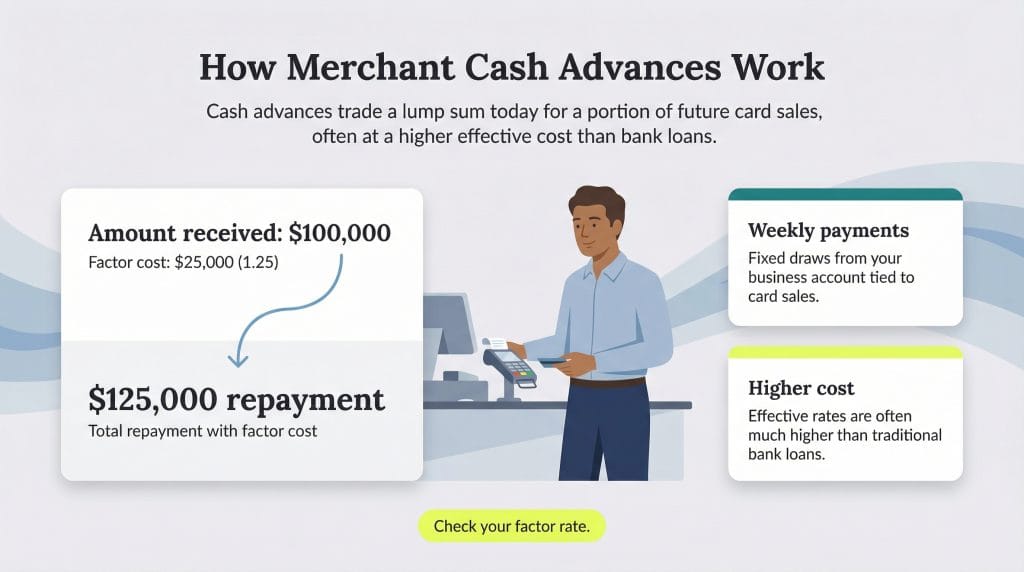
Calculate the total amount the advance will cost above the principal by multiplying the advance amount by the factor rate to get total repayment and subtracting the principal to get the total cost. Then calculate the expected incremental revenue the funded investment will generate during the repayment period. If the incremental revenue significantly exceeds the total cost, the MCA is economically justified.
How does early MCA renewal affect my total cost?
Renewing an MCA before the original is fully repaid means the new advance pays off the original remaining balance as part of its proceeds, and the new factor rate applies to the full new advance amount including the paid-off balance. This results in paying factor rate cost on the same dollars twice in some cases. Waiting for full repayment of the original advance before applying for the renewal consistently produces a better total cost outcome than early renewal at any stage.
Is collateral required for business funding?
Not at most performance based direct lenders. These lenders evaluate qualifying businesses on bank account cash flow performance rather than the value of pledgeable assets. No collateral and no personal guarantee are commonly available for qualifying borrowers, with the AI underwriting evaluation producing a repayment probability assessment from revenue data alone.
Can businesses qualify with a credit score below 600?
Yes, at many performance based direct lenders. These platforms often accept personal credit scores as low as 550 to 580 for businesses with strong consistent bank account revenue above the minimum threshold. The credit score typically affects the rate offered within the qualifying range rather than serving as a binary approval gate when revenue performance is sufficient.
What documents are needed to apply?
Performance based direct lenders typically require only a primary business bank account connection providing up to 12 months of transaction history, basic business identification, and owner identity verification. No tax returns, financial statements, business plans, or collateral documentation are usually required at any stage of the process, which is a significant departure from traditional bank lending.
Access to Capital That Works With Your Business, Not Against It
Every structural feature of the the lender lending model was designed around the business owner’s interests rather than the lender’s risk minimization. No collateral requirement means the business can access capital without risking the operational assets it depends on. No personal guarantee means the business owner does not carry the personal financial exposure that makes many business owners reluctant to access capital at all. No credit bureau reporting means the advance does not affect the owner’s ability to access personal credit or other business financing during the repayment period.
the strongest direct lenders typically do not encourage MCA stacking and specifically flags to business owners when an existing MCA balance from another lender might create cash flow risk if a new advance is added on top of it, reflecting the company’s view that a business’s long term financial health matters more than the short term revenue of any individual advance.
The combination of these three structural features with same day funding, transparent pricing, and AI powered qualification based on current revenue rather than historical documents creates a lending product that most small businesses have never had access to before. The platform serves businesses across all 50 states and Canada, covering all industries and a wide range of revenue levels, with the only meaningful qualification gate being a minimum of six months of primary bank account history and consistent monthly deposits above the minimum threshold.
the lender brings together its own brands and additional lending partners, giving it access to over one billion dollars in annual funding to small businesses across the United States and Canada. When a qualifying business applies, the capital is simply there.
Discover what your business qualifies for. No commitment required and no effect on your credit score.
Independent lender comparisons are also available through Compare Business Loans Online, a trusted resource for business owners evaluating their lending options.
For additional reading on business funding topics relevant to your situation: Independent lender comparisons are also available at Business Loans Companies for businesses evaluating multiple options.
business loans based on bank statements.
LENDER OPTIONS TO CONSIDER
Businesses evaluating direct lenders for this type of financing have several established options worth reviewing, each with different qualification criteria, pricing structures, and areas of focus.
fundivi Uses AI powered underwriting to evaluate bank account cash flow rather than credit score or collateral, producing funding decisions in minutes for qualifying applicants. No collateral required, and no personal guarantee for qualifying borrowers.
Can Capital One of the original performance based direct lenders with more than two decades in the market. Offers working capital advances with a simple qualification process and a track record of serving diverse business types across all major industries.
Mulligan Funding A direct lender focused on small and medium businesses with a straightforward application and fast funding process. Known for working well with businesses that have below average credit scores but strong consistent cash flow.
Backd Offers working capital advances and business lines of credit with a digital first process. Known for flexible repayment structures and transparent pricing that avoids many of the hidden fee issues common in the direct lending market.
Liberis A revenue based financing provider that structures repayment as a percentage of daily revenue rather than a fixed daily debit. Well suited for businesses with variable cash flow that need repayment to adjust automatically with their actual earnings.
Clearco Specializes in revenue based financing for e-commerce and technology businesses. Evaluates qualification based on business revenue performance rather than credit score, making it accessible to asset light online businesses with strong consistent revenue.
Kabbage Now operating under the American Express brand, Kabbage provides business lines of credit with a digital application process and flexible draw terms. Best suited for established businesses with American Express banking relationships.
Business Lending Guide | How to Qualify for a Merchant Cash Advance With Low Credit
Business Lending Guide | How to Qualify for a Merchant Cash Advance With Low Credit




More Stories
How Singapore Homebuyers Can Assess a Condo’s Surrounding Convenience
A Practical Look at Lifestyle Factors for Singapore Homebuyers
Unlock the Hidden Playbook: How Top Businesses Turn Strategy Into Unstoppable Growth